California only
How to file a domestic violence restraining order in California
Direct answer
To ask for a domestic violence restraining order in California, you fill out forms DV-100, CLETS-001, DV-109 (items 1 to 2) and DV-110 (items 1 to 3), file the original plus 2 copies with your county superior court, and have someone else serve the other person before your hearing. There is no court filing fee, and you do not need a lawyer.
California DVRO court process
From filing through renewal, step by step. Deadlines and forms named here match official California Courts guidance and Family Code sections cited on this site.
File the request packet
File the original plus copies in person, by e-file, or in a drop box. There is no court filing fee (Fam. Code § 6222).
The core packet includes DV-100, CLETS-001, DV-109 (items 1-2), and DV-110 (items 1-3). Other forms may apply (for example DV-105 or DV-140 for children).
Forms: DV-100, CLETS-001, DV-109, DV-110
Temporary order decision
The judge decides on the temporary order the same day or the next court day (Fam. Code § 6326).
A signed DV-110 is a temporary order until the hearing. If it is not granted, you can still have a hearing.
Forms: DV-110
Serve the other person
Someone 18 or older who is not you must serve the court-returned papers. You cannot serve your own DVRO papers.
Sheriff or marshal service is free for a restraining-order request. Service is generally at least five days before the hearing (Fam. Code § 243). Read item 6 on the file-stamped DV-109 for the deadline on your notice.
After service, the server completes proof of service (form DV-200 for personal service) and it is filed with the court before the hearing.
Forms: DV-200, SER-001
Restraining order hearing
Fam. Code § 242(a) sets the hearing within 21 days after the temporary restraining order is granted or denied, or within 25 days for good cause; if no temporary order is issued, within 21 days (or 25 for good cause) from the filing date.
Both sides usually get a chance to speak. The judge typically grants or denies the long-term order at the hearing. An order after the hearing can last up to five years.
If the hearing date does not work or service was late, the official route to ask for a new date is form DV-115 before the hearing.
Forms: DV-109, DV-115
Order after the hearing (DV-130)
If the judge grants a restraining order after the hearing, the court issues DV-130 (Restraining Order After Hearing).
California Courts states the protected person must have the order served on the restrained person and must file proof of service.
Forms: DV-130, DV-200, DV-250
Renew before expiration
Before the order expires, renewal uses Request to Renew Restraining Order (DV-700) and Notice of Hearing to Renew Restraining Order (CLETS) (DV-710), with CLETS-001 and a copy of the current order (Fam. Code § 6345).
California Courts states there is no fee and that renewal must be requested before the order expires, with a window that can open up to three months before the expiration date on DV-130 or DV-730.
Forms: DV-700, DV-710, CLETS-001
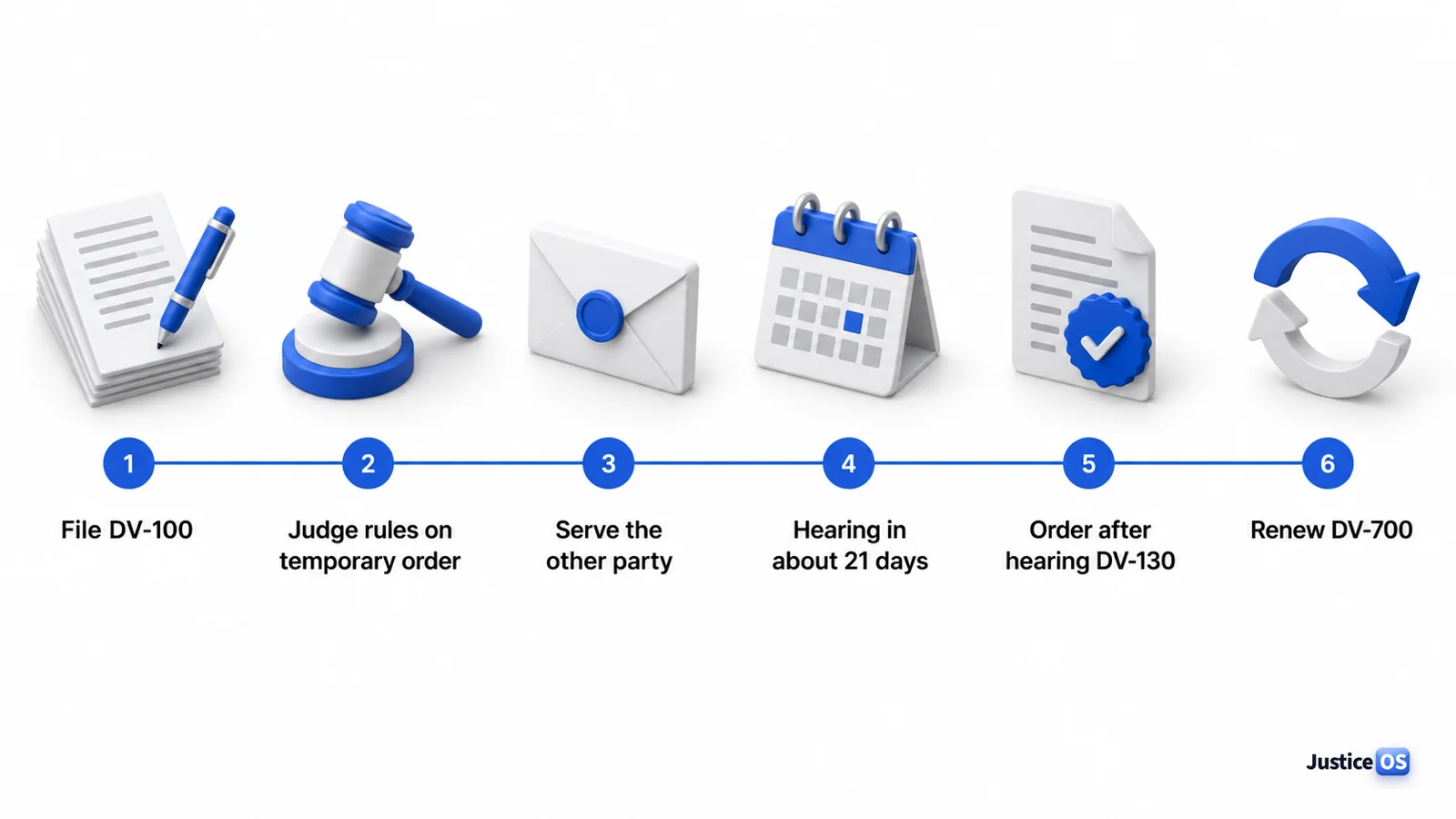
The numbered court process list above is the full text timeline; this image is a visual summary of the same six steps.
If you are in danger right now
Call 911. See our emergency protective order guide for what police can request before you file.
Step 1: Fill out the forms
The core packet includes DV-100, CLETS-001, DV-109 (items 1-2), and DV-110 (items 1-3). Other forms may apply (for example DV-105 or DV-140 for children). The court may have local forms.
JusticeOS fills DV-100, DV-109, DV-110, and CLETS-001 from your answers, plus the Los Angeles FAM-020 cover sheet when your case is in LA County. It does not prepare DV-105 or DV-140; if you need child custody or visitation orders, use the official California Courts forms and file DV-105 with DV-100 and DV-140 with DV-110.
Everything on DV-100 is seen by the other person; CLETS-001 is not. Address privacy guide.
Step 2: File with the court
File the original plus two copies in person, by e-file, or in a drop box (a drop box may be slower). There is no court filing fee (Fam. Code § 6222). Computer-printed forms at 300 dpi or better may be filed (rule 1.44). Find your court.
Step 3: Get your papers back
The judge decides on the temporary order the same day or the next court day (Fam. Code § 6326). A signed DV-110 is a temporary order until the hearing. If it is not granted, you can still have a hearing.
Step 4: Have the other person served
Someone 18 or older who is not you must serve the papers. The sheriff serves free when you provide an address. Service is generally at least five days before the hearing (Fam. Code § 243). File proof with DV-200. Service guide.
Step 5: Go to your hearing
The hearing is generally within 21 days after the temporary order is granted or denied, or 25 for good cause; if no temporary order is issued, within 21 days (or 25 for good cause) from the filing date (Fam. Code § 242(a)). The judge usually decides at the hearing. An order after the hearing can last up to five years. Hearing guide.
How JusticeOS helps
A guided interview fills DV-100, DV-109, DV-110, and CLETS-001 (plus the LA FAM-020 cover sheet for LA cases) from answers you confirm. You review every field. Free Clerk Check catches common completeness problems. You file and serve yourself.
Cost
The court charges nothing to file. JusticeOS charges one payment per case: $19.99. A fee waiver unlocks the same tools at no cost. Pricing. Free tools (/check, /understand) stay free.
Questions people ask next
Is it free to file a DVRO in California?
Yes, no court fee. JusticeOS charges a separate one-time prep fee per case ($19.99); a fee waiver unlocks the same tools at no cost.
Do I need a lawyer?
No. Free court self-help centers exist statewide.
What forms do I need?
DV-100, CLETS-001, DV-109, and DV-110 are the core packet; other forms may apply depending on your requests.
How fast is the temporary order?
Same day or next court day (Fam. Code § 6326).
When is the hearing?
Generally within 21 days after the temporary order is granted or denied, or 25 for good cause; if no temporary order is issued, within 21 days (or 25 for good cause) from the filing date (Fam. Code § 242(a)).
Will the other person see my address?
They receive a copy of DV-100. CLETS-001 is confidential. You may use a mailing address when the form allows.
Who serves the papers?
An adult who is not you; the sheriff serves free when you provide an address.
Can I type the forms and print them?
Yes. Judicial Council forms printed at 300 dpi or better may be filed (Cal. Rules of Court, rule 1.44).
Is JusticeOS a law firm?
Self-help software that helps you fill in forms you choose, at your direction. It does not give legal advice or file for you.
What does Clerk Check do?
Free mechanical checks for versions, blanks, signatures, missing forms, attachments, and mismatched names. It does not judge your facts or predict a decision.
What is AB 1657, and when does it take effect?
AB 1657 (Rogers; chaptered as Chapter 368, Statutes of 2026, approved September 20, 2026; no urgency clause, effective January 1, 2027) amends Fam. Code §§ 6300 and 6326. After that date, courts may not require advance notice before accepting or deciding an ex parte DVRO application, may not require an explanation for not giving notice, may not deny a temporary order in whole or in part for lack of notice, and may not keep conflicting rules or forms. Fam. Code § 6300(c), as amended, bars the clerk from rejecting a complete mandatory-form ex parte packet that identifies both parties. Bill: https://leginfo.legislature.ca.gov/faces/billNavClient.xhtml?bill_id=202520260AB1657
Is AB 1657 in effect today?
No. Until January 1, 2027, Fam. Code §§ 6300 and 6326 and any local court notice rules still apply. A judge still may not deny a temporary order solely because the other person was not notified before the ex parte decision.
Does the packet include DV-105 or DV-140 for children?
JusticeOS prepares DV-100, DV-109, DV-110, CLETS-001, and the Los Angeles FAM-020 cover sheet when your case is in LA County. It does not fill DV-105 (custody request) or DV-140 (custody order); download those from California Courts if your situation requires them and file them with the matching parent form.
Not a law firm
JusticeOS is not a law firm and does not give legal advice. You file and serve yourself; for legal advice, use a court self-help center or a lawyer. California only.
Were you served with a restraining order? How to respond (DV-120)