Served with eviction papers in California? You have 10 court days to respond
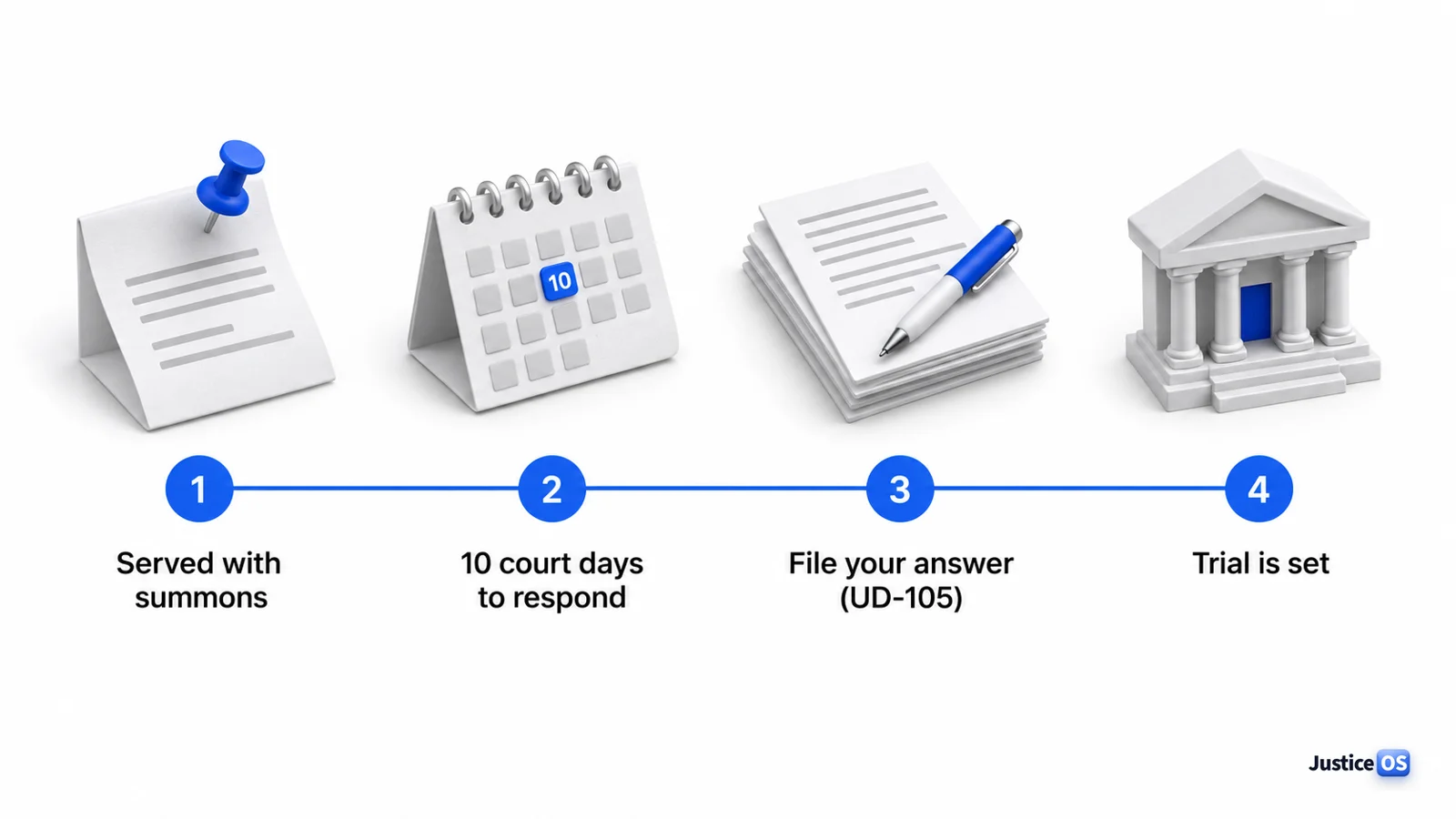
If you were served a Summons (SUM-130) and Complaint (UD-100) for eviction in California, you generally have 10 court days to file a written response, not counting Saturdays, Sundays, or court holidays (CCP § 1167). If service is completed by mail or in person through the Secretary of State's address confidentiality program (Safe at Home), CCP § 1167(b) gives five additional court days—not merely because you are enrolled. If you do not respond, you may lose by default.
Free help: lawhelpca.org and your court self-help center.
Not served yet?
If you rent in the City of Los Angeles and have a notice from your landlord, or only threats, the free check shows the dates that matter, what the law requires of your landlord, and where to get free help. It fills no court forms.
Check where you standEstimate your response deadline
Counted on this page: 10 court days after the date you were served, skipping weekends and California court holidays. Nothing you enter here leaves your device or is stored.
Court holidays this counter skips (2026)
- Thursday, January 1, 2026: New Year's Day
- Monday, January 19, 2026: Martin Luther King Jr. Day
- Thursday, February 12, 2026: Lincoln's Birthday
- Monday, February 16, 2026: Presidents' Day
- Tuesday, March 31, 2026: Cesar Chavez Day
- Monday, May 25, 2026: Memorial Day
- Friday, June 19, 2026: Juneteenth
- Friday, July 3, 2026: Independence Day (observed; July 4 falls on a Saturday)
- Monday, September 7, 2026: Labor Day
- Friday, September 25, 2026: Native American Day
- Wednesday, November 11, 2026: Veterans Day
- Thursday, November 26, 2026: Thanksgiving Day
- Friday, November 27, 2026: Day after Thanksgiving
- Friday, December 25, 2026: Christmas Day
California judicial-branch holidays (Code Civ. Proc. § 135; Cal. Rules of Court, rule 1.10). Dates in other years are computed by the same published rules. Individual courthouses can close on additional days, one more reason to confirm with the clerk.
How the court part works
What happens after court papers are served, step by step. Each step lists the law or court form it comes from.
Court papers are served
The Summons and the Complaint start the case. Write down the date and how they reached you: the time to respond counts from when service is complete.
Forms: SUM-130, UD-100
Sources
- Code Civ. Proc. § 1167(a)
Respond in writing within 10 court days
You are hereWeekends and court holidays do not count. If the papers were served through the Secretary of State's Safe at Home program, the time is 15 court days.
The usual response is the Answer (form UD-105). It is filed at the court, and a copy is served on the landlord, or on the landlord's lawyer if there is one, by someone 18 or older who is not part of the case.
If you cannot pay the filing fee, you can ask the clerk for a fee waiver form.
Other responses, such as a demurrer, a motion to strike, or a motion to quash service, have hearings within days. Free legal help can explain them.
An adult who lives there but is not named in the case, and is served a Prejudgment Claim of Right to Possession, has 10 days to file it. Saturdays and Sundays count; other court holidays do not.
Forms: UD-105, POS-030, FW-001
Sources
- Code Civ. Proc. § 1167(a)
- Code Civ. Proc. § 1167(b)
- Summons, form SUM-130
- Code Civ. Proc. § 1015
- Code Civ. Proc. § 1013a(1)
- Proof of Service by First-Class Mail, form POS-030
- Code Civ. Proc. § 1170(a)
- Code Civ. Proc. § 1170(b)(1)
- Code Civ. Proc. § 418.10(a)(1)
- Code Civ. Proc. § 1167.4(a)
- Code Civ. Proc. § 1174.25(a)(1)
Only if nothing is filed
If no response is filed in time
The court can decide without hearing from you: the clerk can enter a judgment giving the landlord the home and issue the order to remove the tenants right away.
Sources
- Summons, form SUM-130
- Code Civ. Proc. § 1169
A trial date is requested
After a response is filed, the landlord or you can ask the court to set a trial (form UD-150). The trial is held within 20 days of the request, unless everyone agrees to a later date.
Forms: UD-150
Sources
- Request to Set Case for Trial, form UD-150
- Code Civ. Proc. § 1170.5(a)
- Code Civ. Proc. § 1170.5(b)
Trial and judgment
The court hears both sides and enters a judgment. If it finds for the landlord, the judgment gives the landlord possession of the home and can include the rent it finds due.
Sources
- Code Civ. Proc. § 1170.5(a)
- Code Civ. Proc. § 1174(a)
- Code Civ. Proc. § 1174(b)
If the landlord wins: the writ and the sheriff
The court issues a writ of possession when the landlord asks. The sheriff serves it on someone at the home, or posts it there and sends a copy to the tenant.
Anyone still there 5 days after it is served is removed. Mailing adds no extra days.
Belongings left behind can be taken back within 15 days after the landlord gets the home, by paying the reasonable cost of storage.
Until the landlord has the home back, a tenant can ask the court for relief because of hardship. The court grants it only if the rent due is paid.
Sources
- Code Civ. Proc. § 1170.5(a)
- Code Civ. Proc. § 715.020(a)
- Code Civ. Proc. § 715.020(b)
- Code Civ. Proc. § 715.020(c)
- Code Civ. Proc. § 715.010(b)(3)
- Code Civ. Proc. § 1179
What the papers mean, in plain language
The lawsuit
An "unlawful detainer" is California's eviction lawsuit. The packet you were handed is usually a Summons (SUM-130) and a Complaint (UD-100). Being served does not mean you have lost; it means a deadline has started.
The response
Form UD-105, "Answer: Unlawful Detainer," is the Judicial Council form a tenant can use to respond in writing. Filing a response is how a tenant tells the court their side and gets a court date instead of a default.
If nothing is filed
After the deadline passes with no response on file, the landlord can ask the court to decide the case without you (a default judgment), which can lead to a writ of possession and a sheriff lockout.
Free help exists: every California superior court has a Self-Help Center for people without lawyers, and a person with low income can ask the court to waive its filing fee (Form FW-001). Free tenant legal-aid organizations also exist in many counties; the Self-Help Center can point to them.
Prepare your answer
Our UD-105 answer tool is not ready yet. Free help is. Don't wait for us.
- Tenant Power Toolkit: Free, statewide. Builds a UD-105 answer and a fee-waiver request from your answers.
- California Courts: responding to an eviction: The official guide, with the forms and how to file them at your court.
- Stay Housed L.A.: City of Los Angeles and unincorporated L.A. County: free legal help for eligible tenants. Contact them as soon as you are served.
What we are building
- You would answer intake questions in plain language, and the software would place your answers on the official UD-105.
- You would review every line before filing anything, and decide what the form says. Filing stays in your hands.
- You would get a print-ready document and plain instructions for filing it with your court.
What we never do
- We do not give legal advice, choose defenses for you, or recommend what to claim.
- We do not predict what the court will do or score your chances.
- You review everything, you decide everything, and nothing is charged without your explicit go-ahead.
JusticeOS is not a law firm and is not your lawyer. The official UD-105 form itself lists possible defenses; whether any applies to your situation is a judgment only you (or a lawyer) can make. When a question needs a lawyer, we say so and point to free help.
If the eviction is tied to domestic violence
Form UD-105 item 3k lists a defense when an eviction is based on abuse against the tenant or household, with documentation types named on the form. Survivors who need a restraining order can use our DVRO start-to-finish page or free packet check.
Questions people ask next
How many days do I have to respond to an eviction lawsuit in California?
10 court days after service, not counting weekends or court holidays (CCP § 1167). CCP § 1167(b) adds five additional court days to file a response only when service is completed by mail or in person through the Secretary of State’s address confidentiality program (Safe at Home)—not merely because you are enrolled (SUM-130).
Didn't tenants used to get 5 days?
The rule changed to 10 court days on January 1, 2025 (AB 2347).
What form do I use to respond?
UD-105, Answer—Unlawful Detainer, is the Judicial Council answer form. Other responses exist; a court self-help center can explain them.
Does a letter to my landlord count?
No. The summons says a letter or phone call will not protect you (SUM-130).
Is JusticeOS a law firm?
No. JusticeOS is not a law firm and does not give legal advice. We offer free information tools; we do not file for you.