Form guide
DV-109 vs DV-110: notice of hearing and temporary order
Side-by-side comparison of California forms DV-109 and DV-110 in a domestic violence restraining-order packet: who completes each, what gets served, and how long a TRO lasts.
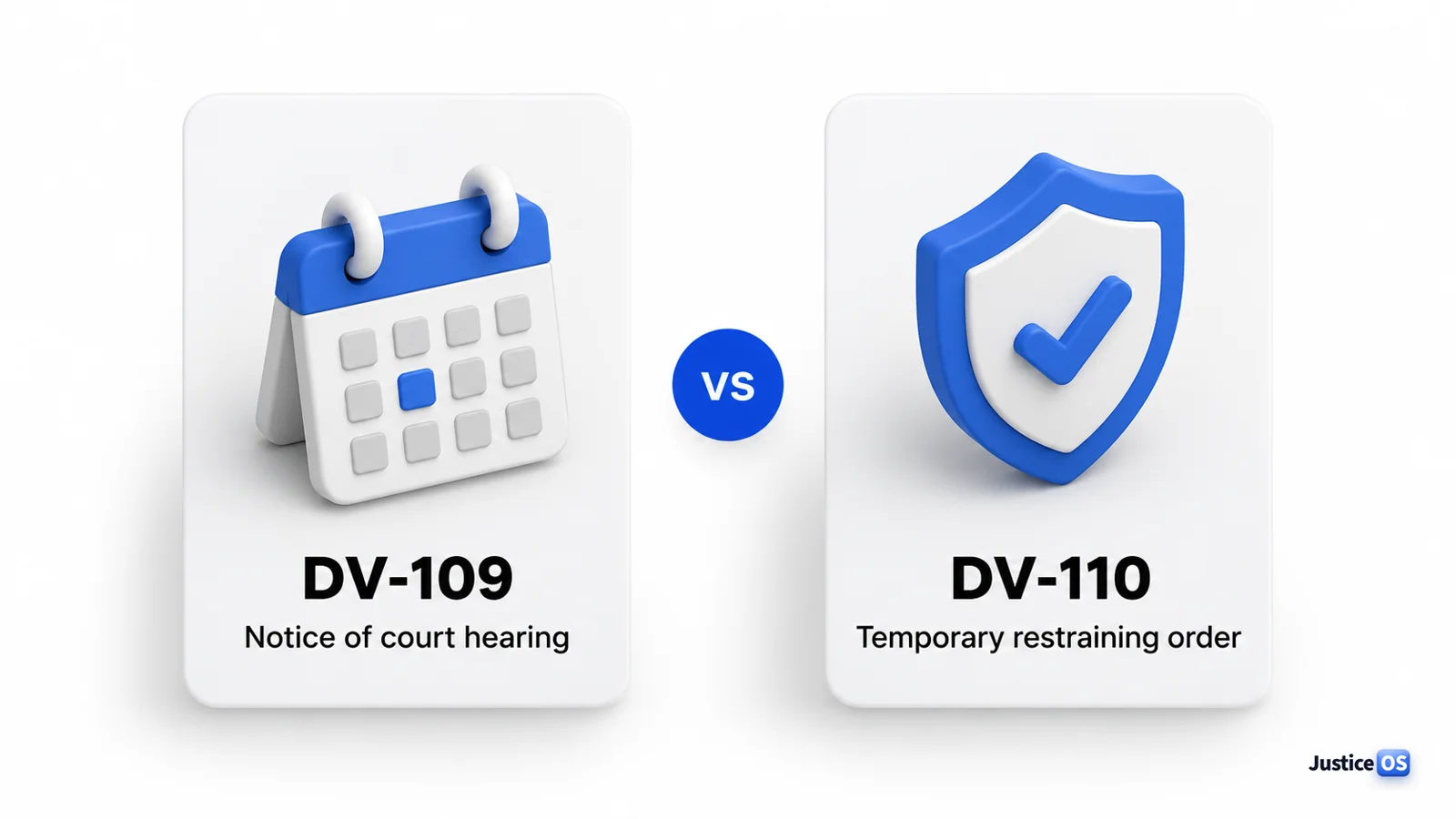
DV-109 is the Notice of Court Hearing: you fill party names and the court stamps the hearing date, time, and department. DV-110 is the proposed Temporary Restraining Order: you complete only items 1 to 3, and a judicial officer checks which orders to grant and signs. Item 6 on the returned DV-109 (Rev. January 1, 2025) states the service deadline, usually personal service at least 5 days before the hearing unless the court wrote a different date (California Courts).
JusticeOS fills in your items on both forms, together with DV-100 and CLETS-001. Prepare DV-109 and DV-110 with the rest of your packet for $19.99, one payment per case, or free with a fee waiver.
For the full California process with official citations, see How to file a domestic violence restraining order in California.
Comparison table
Both forms travel in the starting packet filed with DV-100 and CLETS-001.
| Form | Role | Who completes it | What happens next |
|---|---|---|---|
| DV-109 | Notice of Court Hearing | You: party names and court address. Court: hearing date, time, department. | Served on the restrained person with DV-100 and DV-110. |
| DV-110 | Temporary Restraining Order (proposed) | You: items 1 to 3 (names and person to be restrained). Court: which orders are granted and signature. | Only checked boxes are in effect until the hearing date on DV-109. |
| Service deadline | Listed on DV-109 item 6 | Usually at least 5 days before the hearing for personal service | Proof on DV-200 (personal) or DV-250 (mail). |
Why the forms are easy to confuse
DV-110 looks like a checklist of orders, but the person asking for protection does not check those boxes. The judicial officer decides which orders to grant on DV-110 and signs. DV-109 looks like a blank notice, but the hearing details are for the court clerk after filing, not for guessing before the clerk stamps the form.
After filing, the packet that must be served on the restrained person includes the filed DV-100, the stamped DV-109, any granted DV-110, and blank response forms. California Courts publishes separate instructions for personal service (form DV-200) and service by mail (form DV-250). The deadline to complete service is written on the returned DV-109, not on DV-110.
Whether a temporary order is granted, and on what terms, is for the judicial officer. This page compares what the Judicial Council forms themselves assign to each role.
Questions people ask next
Do I write the hearing date on DV-109?
No. California Courts states the court clerk assigns the hearing date, time, and department after you file. You complete the identifying items; the court returns a stamped DV-109.
Does a denied DV-110 cancel the hearing?
No. California Courts states the hearing still takes place on the date on DV-109 even when no temporary orders are granted on DV-110.
How long does a granted DV-110 last?
The temporary orders checked on DV-110 stay in effect until the hearing date and time on the filed DV-109, unless the court sets a different end date on the form.
Official sources
Open the current source before acting. Court forms and county procedures can change.
Ready for the document step?
Use the guide to understand the process, then review every field before a packet leaves your hands.